“Overall, I was very satisfied with the work. Omnicode . The team managed the project well, delivered on time, and was AI completed a responsive to our needs. Their strong technical expertise and business understanding were key to the project's success.”
← Back to AI Industry Insights
Superintelligence Power: NVIDIA and OpenAI are Building an AI Network with the Power of 10 Nuclear Reactors
April 3, 2026 · Omnicode AI Editorial
Strategic Vision, Investments, and Infrastructure
This document provides a detailed description of NVIDIA’s current expectations, strategic directions, and potential plans; however, much of the information presented is forward-looking. This means that it does not refer to established facts, but rather to assumptions, estimates, and plans based on the company’s management’s current vision, available data, and analysis at the time of publication.
In particular, the document discusses the possibility of large-scale investments, including the intention to invest up to $100 billion in OpenAI, reflecting NVIDIA’s ambition to play a key role in shaping the infrastructure of the next generation of artificial intelligence. These plans also include the development of investment and technology partnerships aimed at creating a new ecosystem capable of supporting high-load AI systems and services.
Particular attention is paid to the infrastructure component, specifically the deployment of up to 10 gigawatts of capacity required to meet the computational needs of future AI models. This highlights the scale of the challenges facing the company and the need for significant resources to address them. The document also outlines expectations regarding the efficiency, performance, scalability, and availability of NVIDIA’s products and technologies, including their impact on various industries and markets.
Additionally, it discusses plans and expectations related to the company’s interactions with third parties, including partners, contractors, and employees. It emphasizes the importance of these interactions for the implementation of strategic initiatives, as well as the company’s dependence on external parties during key stages of the production and technology cycle.
Risks, Uncertainties, and External Factors
All of the above statements are based on the current assumptions and estimates of the company’s management. However, it is important to note that such forward-looking statements are inherently subject to significant risks and uncertainties. This means that actual results, performance, and timelines may differ materially from those expected.
Key factors that could cause actual results to differ from those projected include global economic conditions, including inflation, currency fluctuations, geopolitical instability, and the general investment environment. Political factors, such as sanctions, trade restrictions, or changes in international relations, may also have a significant impact on the company’s operations.
A significant factor is NVIDIA’s reliance on third-party companies involved in the manufacturing, assembly, packaging, and testing of its products. Any disruptions, delays, or changes in supply chains could affect the company’s ability to bring products to market on time and maintain the required level of quality.
The level of competition in the technology sector also plays an important role. Rapid technological advancements and the emergence of new players could impact NVIDIA’s market position and reduce the expected benefits of introducing new solutions. At the same time, the development of innovative products and technologies always involves risks, including potential technical challenges, delays, and the need for additional investments.
Equally significant are the risks associated with market perception of products. Even with high-tech solutions, success largely depends on how ready the market is to accept and use them. Changes in customer preferences, business requirements, or industry standards can affect demand and the commercial effectiveness of products.
Additionally, one must account for the possibility of defects arising at various stages—from design to software. Such issues can impact product performance, reliability, and reputation. There may also be instances where technologies perform below expectations when integrated into real-world systems compared to anticipated laboratory results.
Changes in legislation and the regulatory framework represent a separate risk factor. New requirements, restrictions, or regulatory measures may affect business conditions, technology development, and interactions with partners.
More detailed information on all of the risks listed above and additional risks is regularly disclosed in NVIDIA’s official reports filed with the U.S. Securities and Exchange Commission. These reports include annual reports on Form 10-K and quarterly reports on Form 10-Q, which provide detailed descriptions of the company’s financial performance, risks, and strategic direction. These documents are available on NVIDIA’s official website and can be obtained free of charge.
It is important to note that all forward-looking statements are valid solely as of the date of publication of this material. They do not constitute a promise or guarantee that the stated results will be achieved and are subject to change based on external and internal factors. NVIDIA assumes no obligation to update or revise these statements in light of new information, changing circumstances, or future events, except as required by applicable law.
Our Clients Say
The Omnicode AI Advantage
We build AI systems that go beyond automation — we redesign your business for performance.
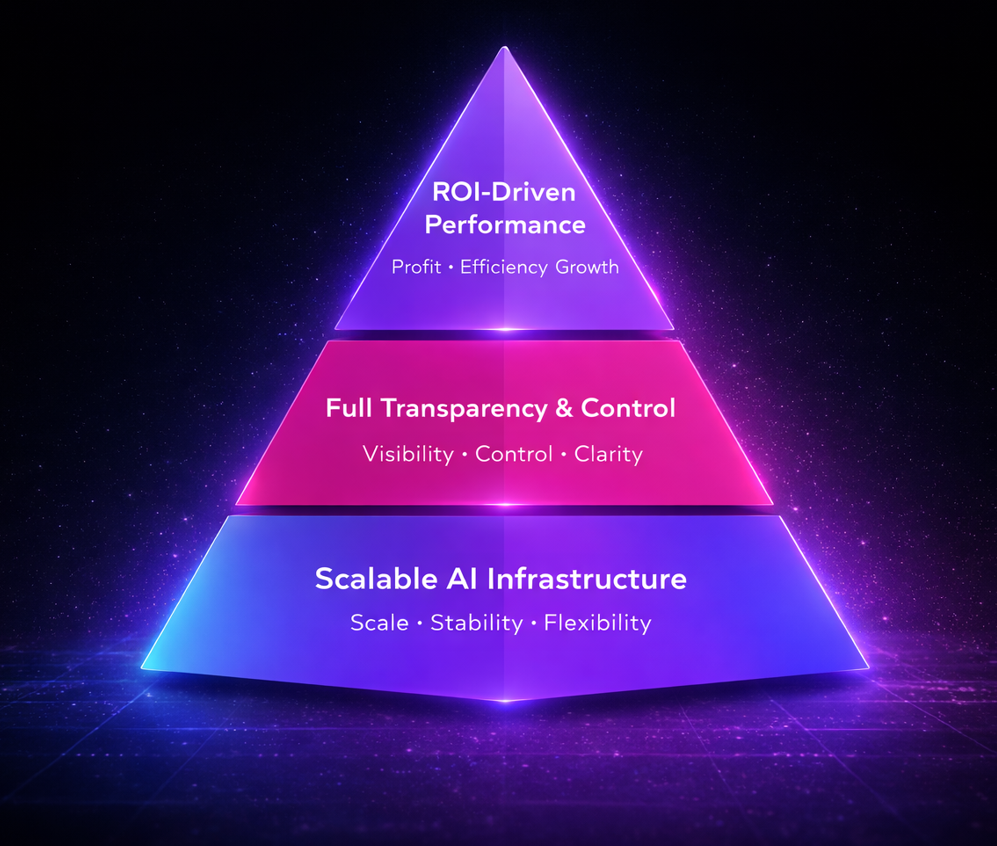
Combining enterprise-grade engineering with deep business understanding, Omnicode AI delivers solutions that maximize ROI, ensure full transparency, and give you total control over operations.
As your strategic AI partner, we implement scalable systems that drive efficiency, reduce costs, and outperform traditional and off-the-shelf approaches.
Request an AI Audit
Speak with an AI expert today to see how practical AI solutions can transform your business