“Overall, I was very satisfied with the work. Omnicode . The team managed the project well, delivered on time, and was AI completed a responsive to our needs. Their strong technical expertise and business understanding were key to the project's success.”
← Back to AI Industry Insights
The Magic of Cold: How AI Predicts Customer Desires and Saves Supply Chains at The Magnum Ice Cream Company
April 5, 2026 · Omnicode AI Editorial
Scale and Complexity of the Supply Chain
This article provides a detailed look at how Unilever is transforming its global ice cream supply chain using artificial intelligence, turning a traditional, largely reactive system into a proactive, flexible, and highly efficient infrastructure capable of quickly adapting to changes in the external environment and ensuring sustainable business growth.
Unilever’s ice cream supply chain is one of the largest and most complex in the world. It spans more than 60 countries, includes approximately 35 manufacturing sites, and manages a network of roughly 3 million freezer cases located at various retail outlets. This scale requires not only precise planning but also constant coordination between production, logistics, and sales.
The main characteristic of this business is its high dependence on weather conditions. Unlike many other product categories, demand for ice cream is directly linked to air temperature and seasonal changes. Even a slight increase in temperature—for example, just one degree during a summer month—can significantly boost sales. At the same time, a sudden cold snap can lead to a drop in demand and a buildup of excess inventory.
In the past, such fluctuations created serious challenges. Forecasts were based primarily on historical data and standard models that did not always account for current changes in the environment. This led to inaccurate forecasts, inefficient resource allocation, product losses, and a decline in overall profitability.
AI-Driven Forecasting and Demand Management
With the introduction of artificial intelligence, the approach to supply chain management began to change dramatically. The company started using more advanced analytical tools that allow for the simultaneous consideration of multiple factors. In addition to historical data, the analysis includes weather forecasts, consumer behavior, regional characteristics, and real-time data.
One of the key areas has been the use of AI to analyze weather data. Modern algorithms allow not only for recording current temperatures but also for forecasting probabilistic scenarios of changing weather conditions. This makes it possible to anticipate potential fluctuations in demand and prepare the system for various possible outcomes.
For example, instead of a single fixed forecast, the company now works with probability ranges. This allows for more flexible production planning, adjusting output volumes in advance, and minimizing risks associated with uncertainty. As a result, forecast accuracy has significantly improved. In certain regions, such as Sweden, the improvement was approximately 10 percent.
More accurate forecasting directly impacts production efficiency. Understanding where, when, and in what volume products will be in demand allows for optimal utilization of production lines, avoids overproduction, and reduces costs. It also contributes to a more efficient use of raw materials and a reduction in waste.
Operational Optimization: Production, Logistics, and Computer Vision
In addition, artificial intelligence helps companies respond more quickly to short-term changes in demand. If a region experiences an unexpected rise in temperature and, consequently, an increase in demand, inventory management systems allow companies to quickly determine product availability and redistribute it across regions. This ensures high product availability and prevents lost sales.
Logistics optimization also plays a key role. The use of AI enables the analysis of delivery routes, takes into account the capacity of the transportation infrastructure, and minimizes transportation costs. In particular, refrigerated transport routes are optimized, which not only reduces costs but also lowers energy consumption.
Special attention is paid to improving the efficiency of production processes. Factories are implementing artificial intelligence systems that operate in real time and analyze key production parameters. This allows for the rapid identification of deviations, the optimization of equipment settings, and an increase in overall productivity.
The use of such systems also helps reduce raw material waste. In some cases, savings reach up to 10 percent, which is particularly important for expensive ingredients such as vanilla and cocoa. This not only lowers production costs but also increases the overall profitability of the business.
One of the most significant innovative solutions has been the implementation of computer vision technologies in freezer display cases. Currently, approximately 100,000 display cases are equipped with artificial intelligence systems that allow for real-time inventory tracking. These systems analyze images, determine product availability, and transmit data to centralized management systems.
This solution fundamentally changes the approach to forecasting and inventory management. Instead of relying on rough estimates and periodic reports, the company receives accurate and up-to-date information on inventory status. This enables more informed decision-making and significantly improves the efficiency of the entire supply chain.
By integrating data from various sources, including production systems, logistics platforms, and retail locations, a unified digital environment is created. In this environment, all processes become transparent, and decision-making becomes faster and more accurate.
Business Impact, Workforce Transformation, and Future Outlook
The result of this transformation has been not only increased efficiency but also improved customer service. Products become more accessible, deliveries more reliable, and responses to changes in demand more timely. This allows the company to strengthen its market position and increase customer satisfaction.
In addition, the implementation of artificial intelligence has a significant impact on the company’s employees. The automation of routine tasks frees up specialists’ time, allowing them to focus on more complex and strategically important tasks. This increases overall productivity and contributes to the development of professional skills.
An example of the successful application of such technologies is the experience of a manager responsible for long-term supply chain planning for ice cream, for whom weather data has become one of the key tools in their work. Thanks to the use of AI, the team gained the ability not only to forecast demand more accurately but also to develop more flexible management strategies.
Recognition from industry experts served as important confirmation of the effectiveness of the chosen approach. In 2024, the company was recognized by the research firm Gartner as one of the leaders in supply chain management. This recognition reflects the high level of maturity of digital processes and the successful integration of artificial intelligence technologies.
It is worth noting that supply chain transformation is not a one-time change, but a continuous process. The company continues to invest in technology development, expand the use of artificial intelligence, and improve its systems. In particular, it plans to further implement computer vision-based solutions in all freezer display cases, which will further improve data accuracy and management efficiency.
The future of supply chains will be largely determined by the level of digitalization and companies’ ability to work with data. Organizations that can effectively integrate artificial intelligence into their processes will gain a significant competitive advantage. They will be able to adapt more quickly to changes, better understand customer needs, and use resources more efficiently.
In the case of Unilever, it is already evident today how data and technology are becoming the foundation for decision-making. The use of real-time analytics, the integration of various systems, and the implementation of intelligent algorithms enable the company to create a more sustainable and flexible business model.
Thus, artificial intelligence is becoming not just a tool for optimization, but a strategic factor that determines business development. It enables a shift from reactive to proactive management, from intuitive decisions to data-driven ones, and from fragmented processes to a unified, coordinated system.
Ultimately, this leads to cost reductions, increased efficiency, improved service quality, and business growth. The company gains the ability not only to adapt to market changes but also to actively shape the market by setting new standards in supply chain management.
Digital transformation and the adoption of artificial intelligence are becoming key drivers of growth and sustainable development. In a highly competitive and rapidly changing environment, these factors determine which companies will lead and which will fall behind.
Unilever demonstrates how the effective use of data, technology, and analytics can transform a traditional industry and create new opportunities for growth. By using AI for forecasting, optimization, and management, the company is shaping the future of its supply chain and its business as a whole.
Using Artificial Intelligence in Supply Chains to Improve Customer Service
Unilever is actively transforming its customer engagement model by implementing artificial intelligence-based solutions and developing partnerships based on deep data integration. The primary goal is to ensure customers have consistent access to the high-quality products they need at their convenience—whether they purchase in-store or through online channels.
The company's modern supply chains are becoming more flexible and intelligent through the use of real-time analytics. This enables them not only to more accurately forecast demand but also to quickly respond to changes, ensuring consistent product availability at points of sale. This approach significantly improves customer service and reduces the likelihood of product stockouts.
In the "Voices in Transformation" podcast, company representatives share their practical experience implementing such solutions. They note that collaboration with major retail partners such as Amazon, Walmart, and Tesco plays a key role in this process. By sharing data and synchronizing processes, the company gains a more accurate understanding of consumer behavior and can more quickly adapt its supply chain to real market needs.
An additional important focus is developing internal competencies. The DigiOps program is aimed at enhancing employee skills in digital technologies and data management. This enables teams not only to effectively utilize implemented solutions but also to actively participate in the further development of innovations.
As a result of this integrated approach, Unilever's supply chains are becoming more than just a means of product delivery, but a strategic element directly impacting the quality of customer experience, customer satisfaction, and the overall competitiveness of the business.
Our Clients Say
The Omnicode AI Advantage
We build AI systems that go beyond automation — we redesign your business for performance.
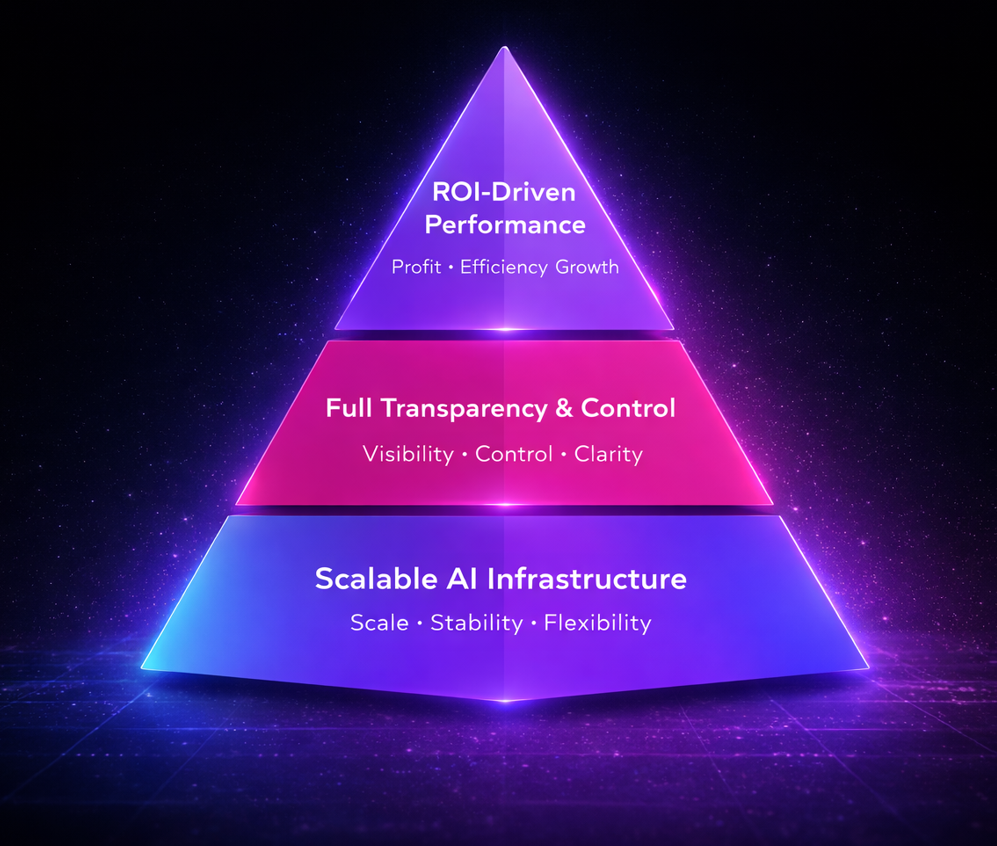
Combining enterprise-grade engineering with deep business understanding, Omnicode AI delivers solutions that maximize ROI, ensure full transparency, and give you total control over operations.
As your strategic AI partner, we implement scalable systems that drive efficiency, reduce costs, and outperform traditional and off-the-shelf approaches.
Request an AI Audit
Speak with an AI expert today to see how practical AI solutions can transform your business