“Overall, I was very satisfied with the work. Omnicode . The team managed the project well, delivered on time, and was AI completed a responsive to our needs. Their strong technical expertise and business understanding were key to the project's success.”
← Back to AI Industry Insights
How AI Solved the Massive Energy Efficiency Challenge at Google
April 11, 2026 · Omnicode AI Editorial
In an era of rising energy costs and urgent environmental mandates, the industrial sector is facing a critical challenge: how to maintain massive computational and production power while drastically reducing energy footprints. Traditional engineering, while effective for decades, has reached a plateau where major breakthroughs are rare. AI has emerged as the definitive solution to this dilemma, moving beyond simple automation to become a strategic manager of energy resources. By processing vast streams of sensor data from cooling systems, power grids, and heavy machinery, AI identifies subtle inefficiencies that escape even the most experienced human operators. This predictive intelligence allows facilities to transition from static energy management to a dynamic, responsive model that anticipates demand and optimizes consumption in real-time.
Real-World Impact: How Google and DeepMind Redefined Cooling Efficiency
One of the most profound examples of AI-driven energy optimization comes from Google’s collaboration with DeepMind. Data centers are the backbone of the modern internet, but they are also massive heat generators that require complex industrial equipment—pumps, chillers, and cooling towers—to function. The primary challenge is the nonlinear interaction between equipment settings, weather conditions, and server loads. To solve this, DeepMind researchers trained an ensemble of deep neural networks on historical data from thousands of sensors. By predicting the future Power Usage Effectiveness (PUE) and simulating recommended actions within safe constraints, Google achieved a staggering 40% reduction in energy used for cooling and a 15% reduction in overall energy overhead. This represents the lowest PUE the sites had ever recorded, setting a new global benchmark for industrial sustainability.
Autonomous Energy Management and the Mitigation of Operational Costs
The success of AI in energy optimization lies in its ability to manage "complex equilibrium." In large-scale industrial environments, adjusting a single variable—such as a fan speed or a water chiller temperature—can have a cascading effect on the entire system. AI algorithms excel at managing these interdependencies, ensuring that the system remains at its most efficient state regardless of external fluctuations or internal demand spikes. This autonomous management significantly reduces operational costs by flattening "peak load" demands and preventing the unnecessary over-cooling of equipment. For global enterprises, this translates into millions of dollars in annual savings and a direct path to achieving net-zero carbon commitments without sacrificing the reliability of their mission-critical infrastructure.
Beyond Data Centers: Scaling Energy Intelligence Across Heavy Industry
The principles applied by Google are not limited to the technology sector; they are scaling across diverse industrial fields, from semiconductor manufacturing to heavy power plants. Because the underlying algorithm is a general-purpose framework designed to understand complex dynamics, it can be adapted to improve power plant conversion efficiency or reduce water usage in manufacturing. These AI systems act as a digital overlay, optimizing the performance of legacy equipment through smarter orchestration without requiring expensive physical overhauls. As industries continue to face pressure to reduce their environmental impact, the ability to turn raw energy data into actionable foresight will be the primary differentiator between efficient market leaders and those burdened by soaring operational costs.
The Synergy of Sustainability and Long-Term Profitability
Ultimately, the integration of AI into energy management proves that environmental sustainability and financial profitability are deeply synergistic. By minimizing energy waste, AI directly boosts the bottom line while simultaneously future-proofing the organization against tightening carbon regulations and energy price volatility. This data-driven approach fosters a new culture of "Energy ROI," where every watt consumed is measured and optimized for maximum output. As we move toward a more electrified and digitized global economy, the role of AI as an energy architect will be indispensable, providing the intelligence needed to power the next generation of industrial growth in a cleaner, more resilient, and cost-effective manner.
Our Clients Say
The Omnicode AI Advantage
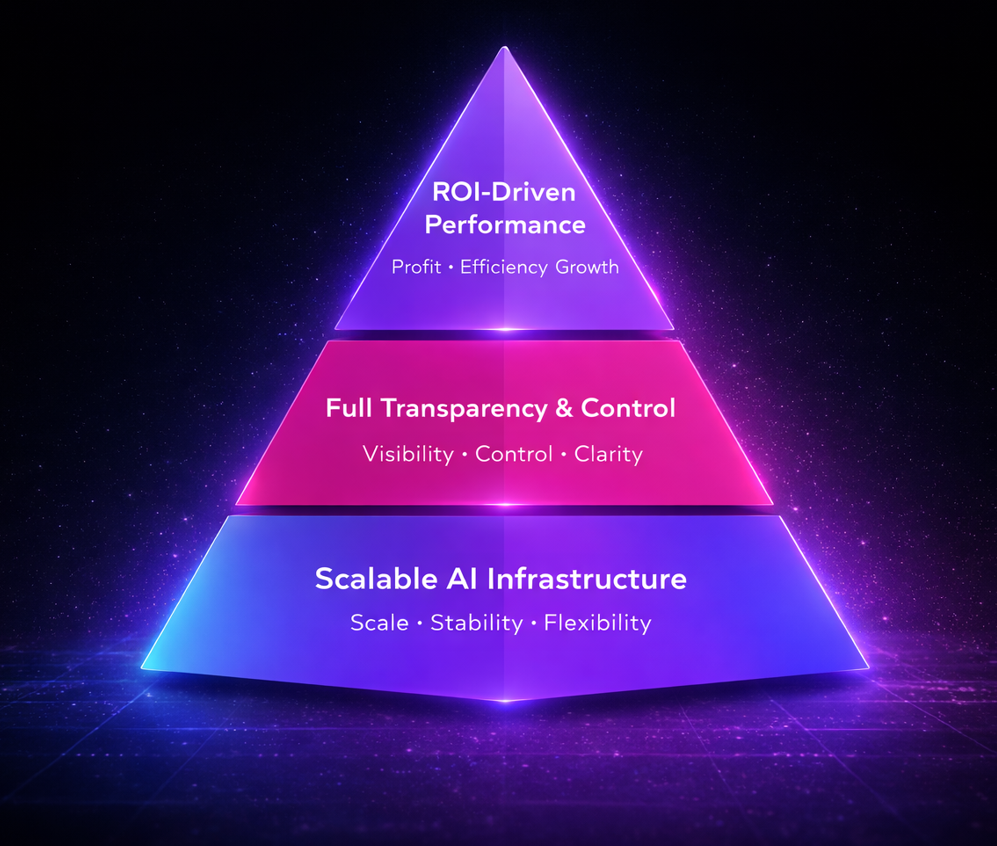
We build AI systems that go beyond automation — we redesign your business for performance.
Combining enterprise-grade engineering with deep business understanding, Omnicode AI delivers solutions that maximize ROI, ensure full transparency, and give you total control over operations.
As your strategic AI partner, we implement scalable systems that drive efficiency, reduce costs, and outperform traditional and off-the-shelf approaches.
Request an AI Audit
Speak with an AI expert today to see how practical AI solutions can transform your business