“Overall, I was very satisfied with the work. Omnicode . The team managed the project well, delivered on time, and was AI completed a responsive to our needs. Their strong technical expertise and business understanding were key to the project's success.”
← Back to AI Industry Insights
How AI Solved Grid Instability for GE Digital
April 11, 2026 · Omnicode AI Editorial
The traditional energy grid, originally engineered for a simplistic, one-way flow of electricity from massive, centralized power plants to passive consumers, is fundamentally ill-equipped to handle the dynamic requirements of the 21st century. Today’s energy landscape is defined by a rapid and complex shift toward decentralization, fueled by the integration of intermittent renewable sources like wind and solar, as well as the exponential rise in demand from the global transition to electric vehicles (EVs). This complexity has introduced a massive, high-stakes challenge for utility providers: how to maintain a perfectly stable, frequency-balanced grid when both supply and demand are in a state of constant, unpredictable fluctuation. AI-powered smart grids have emerged as the definitive solution to this instability, transforming the grid from a rigid, passive infrastructure into an intelligent, self-aware network. By synthesizing millions of data points from smart meters, IoT sensors, and high-resolution weather satellites, AI optimizes the distribution of energy in real-time, ensuring that power is routed with surgical precision to where it is needed most while minimizing the significant energy losses that typically occur during long-distance transmission.
Real-World Impact: How GE Digital is Solving Grid Instability with AI
One of the most significant and successful implementations of this technology is led by GE Digital, which provides sophisticated AI-driven software to major utility companies worldwide to manage the next generation of "Smart Grids." The primary operational crisis faced by these providers is the inherent unpredictability of renewable energy—often referred to as "intermittency"—and the dangerous risk of localized surges that can lead to cascading blackouts. GE’s AI orchestration platforms, such as GridOS, utilize advanced machine learning architectures to perform "load forecasting" and "generation forecasting" with a level of accuracy that human operators simply cannot match. By analyzing historical consumption patterns alongside real-time atmospheric data, the system can predict exactly how much energy a specific wind farm will produce and exactly how much a neighborhood will consume in the next hour. This allows the system to balance the load autonomously, preventing the costly over-generation of power—which traditionally leads to massive energy waste—and ensuring that the grid remains resilient even during extreme weather events or sudden, volatile shifts in consumer behavior.
Autonomous Demand Response and the Strategic Reduction of Peak Load Stress
The true transformative power of an AI-driven smart grid lies in its capacity to manage "demand response" through autonomous, machine-to-machine communication without the need for manual human intervention. During peak periods, when global energy consumption reaches its daily height, the resulting stress on the grid infrastructure can lead to astronomical operational costs and potential system-wide failures. AI algorithms solve this by communicating directly with industrial energy management systems, commercial HVAC networks, and smart home devices to subtly and intelligently shift non-critical energy usage to off-peak times. This autonomous orchestration effectively flattens the demand curve, drastically reducing the reliance on expensive, high-emission "peaker" power plants that are typically only activated during emergencies. For utility companies, this translates into hundreds of millions of dollars in annual operational savings and a far more stable, predictable environment for their customers, effectively turning the grid into a self-healing ecosystem that detects and reacts to stress before it ever reaches a crisis point.
Predictive Reliability: Mitigating Infrastructure Failure and Minimizing Outage Times
Beyond the immediate balancing of supply and demand, AI is revolutionizing the physical maintenance and long-term reliability of the energy grid's aging hardware. Traditional grid maintenance has historically been reactive—focused on fixing transformers, substations, or high-voltage lines only after they have already failed. GE Digital and other global technology leaders are now utilizing AI to perform predictive health monitoring across thousands of miles of critical infrastructure. By identifying microscopic anomalies—such as abnormal heat signatures, specific harmonic distortions, or minute voltage fluctuations—through remote IoT sensors, the AI can predict with high probability which specific component is likely to fail next. This allows specialized maintenance teams to perform "surgical" repairs during pre-planned, low-impact downtime, which drastically reduces both the duration and frequency of unplanned outages. This proactive reliability is a critical requirement for modern "Smart Cities," where even a few minutes of total power loss can result in massive economic disruption, data loss, and significant public safety risks.
The Synergy of Renewable Integration and the Future of Global Energy Security
Ultimately, the transition to AI-powered smart grids is the fundamental key to a sustainable, decarbonized, and secure energy future. By allowing for the seamless and efficient integration of distributed energy resources (DERs)—such as residential rooftop solar panels, community-based wind projects, and large-scale battery storage—AI is effectively democratizing the entire energy landscape. It transforms traditional consumers into "prosumers" who can not only use energy but also contribute stored power back to the grid during times of peak national need. This data-driven approach fosters a new era of energy security, where the grid is no longer a vulnerable, centralized target but a diversified, decentralized, and intelligent network capable of redirecting itself in the face of physical or cyber interference. As we move toward a fully electrified global economy, the ability to manage the overwhelming complexity of energy distribution with AI will be the primary factor in achieving global carbon-neutrality goals while maintaining the absolute reliability and resilience of the world’s power systems.
Our Clients Say
The Omnicode AI Advantage
We build AI systems that go beyond automation — we redesign your business for performance.
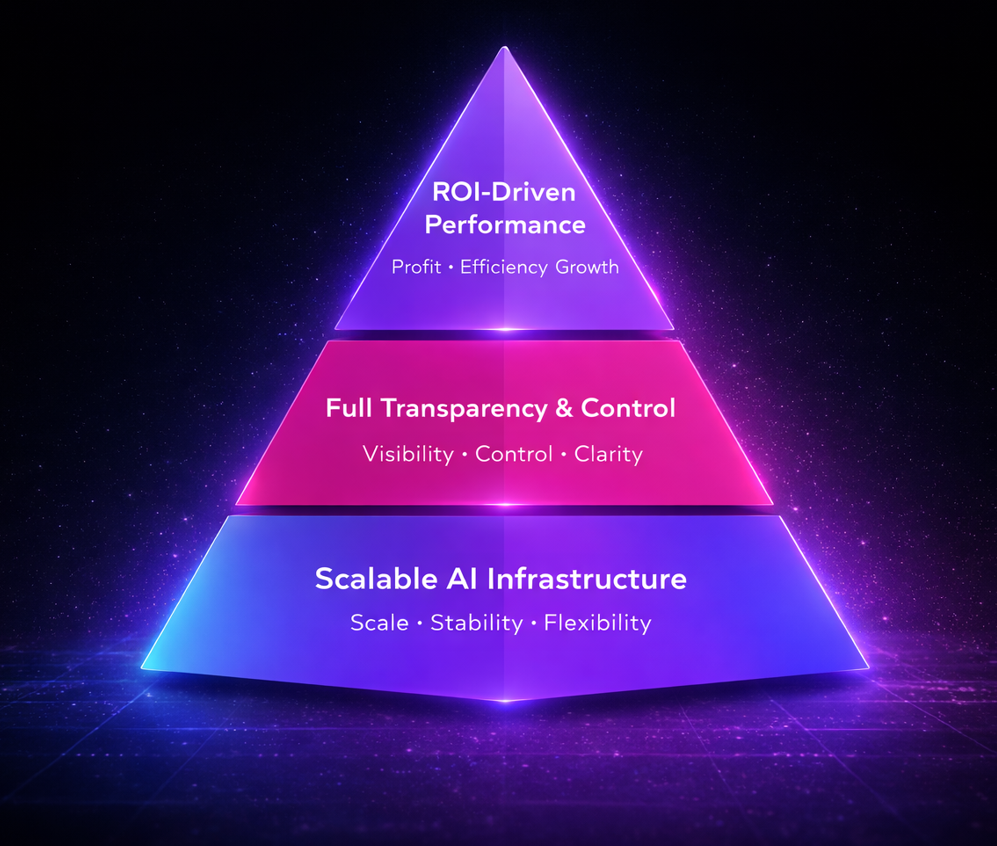
Combining enterprise-grade engineering with deep business understanding, Omnicode AI delivers solutions that maximize ROI, ensure full transparency, and give you total control over operations.
As your strategic AI partner, we implement scalable systems that drive efficiency, reduce costs, and outperform traditional and off-the-shelf approaches.
Request an AI Audit
Speak with an AI expert today to see how practical AI solutions can transform your business